When Part of a South Bend House Sinks: Piers, Lifting and Their Limits
Settling foundation repair in South Bend covers a corner of the house that has dropped, a porch or stoop tipping away from the wall, or a basement floor that has sagged in one area. The cause is almost always below the footing: soft organic soil, ground that stays wet, or fill that was never compacted.
Angi's 2026 data puts settling repairs at $5,000–$25,000, with piering at $1,000–$3,000 per pier, and HomeGuide (2025) lists helical piers at $2,000–$4,000 each. A dropped porch or garage slab can often be lifted for $500–$1,300 (Angi, 2026) if the ground under it has stopped moving.
Is it settling, frost heave or a bowing wall?
Settling moves down and usually stays down: stair-step cracks wider at the top than the bottom, doors out of square, a floor that slopes toward one corner. Frost heave lifts in winter and drops back in spring, mostly on porches, stoops and garage slabs with shallow footings. A bowing wall moves inward, not down. Mixing them up is expensive, because piers do nothing for a bowing wall and anchors do nothing for a sinking corner.
Where does South Bend ground give way under a house?
Three places come up again and again. The first is organic muck: St. Joseph County's soil survey maps Houghton muck, formed in plant material more than 51 inches thick, in depressions and drainageways, and the USDA's ratings list subsidence among the limits for basements on soils like it. The second is wet lowland soil such as Gilford, whose water table rises to the surface from December to May. The third is fill: lots that were raised or leveled before the house went up, which may settle for years if the fill was loose. Sand that drains well is rarely the problem on its own.
Push piers, helical piers and slab lifting
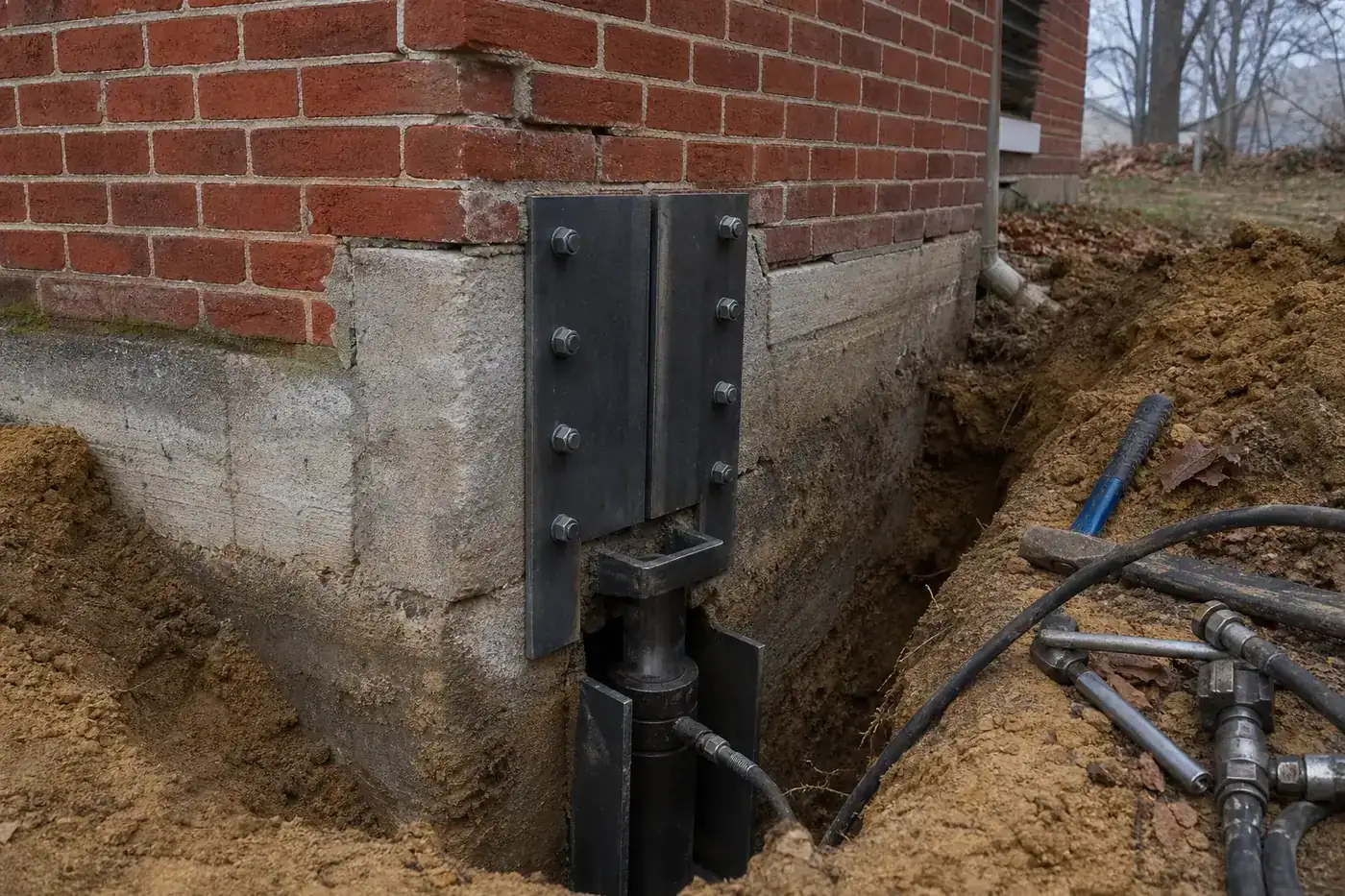
- Push piers: steel tubes pressed into the ground next to the footing, with the house itself as the counterweight, until they meet soil that resists; brackets then carry the load.
- Helical piers: screwed in like large augers, measuring resistance as they go; they suit lighter loads such as porches and additions.
- Slab lifting: foam or grout pumped under a sunken porch, walk or garage floor. It is cheaper, but it does not reach soil below the slab, so it holds only where the ground has settled out.
Prices for each are on the foundation repair cost page for South Bend.
Questions for anyone proposing piers
How deep do you expect to reach firm soil, and how will you know when you have? How many piers, how far apart, and who decided? Will you try to lift the house, or only stop it? What happens to plumbing, the porch and any finished walls along the way? For a corner that is still moving, Angi's 2026 data puts a structural report at $300–$1,000, a modest cost next to a pier job.
Questions homeowners ask
Will piers make my sloping floors level again?
Possibly, not always. Piers can lift a footing back toward its original line, but a house that settled years ago has framing, plaster and doors that adjusted to the new shape, and lifting too far can crack them. Many specialists aim to stabilize first and lift only as far as the house tolerates. Ask what lift they plan.
What is the house doing?
A crack you keep checking, water along the floor after the snow melts, a porch pulling away: one or two sentences is plenty. It goes to one independent foundation and waterproofing specialist who works in South Bend.